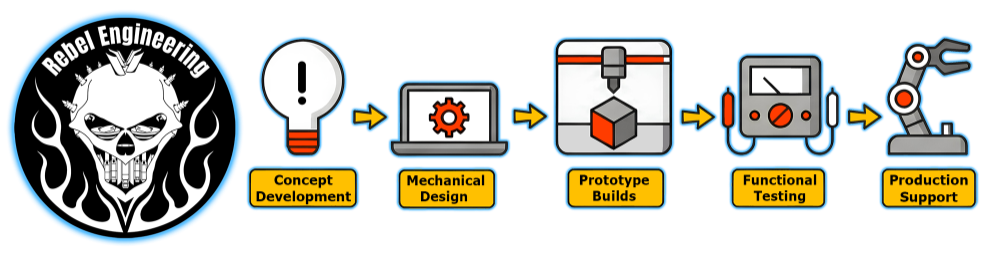
Most product founders don't fail because their idea is bad. It's the small decisions or lack of decisions that tend to take you down. The worst part is you probably won't even know until it's too late. It's almost never these key features that are giving you all the headaches. It's often a simple insignificant seaming issue. It could be incompatible metals that cause galvanic corrosion. Or [snorts] maybe you used a screw that just wasn't large enough or was the wrong grade and breaks in use. Or it could be the plastic molded part that breaks in an area you didn't even consider. I'm going to discuss why physical products fail in boring but very expensive way. Hopefully, this video can help you eliminate or identify where some of these minefields might be hiding. It's not because you're careless. It's not because you're not smart enough. It's because mechanical design and manufacturing punishes these small details in very big ways. I've seen founders lose money way before they even get to the tooling process. I've seen engineers, including myself, redesigning the same part three different times. I've seen simple products turn into five figure problems. It's usually not the problems that you are aware of. It's what you don't know that get you in trouble. This is a new channel for me and I'm trying to get this information out as quickly as possible. So, hit that subscribe button. It'd be a huge help for me. Today, I'm going to break down some design and engineering mistakes that can cost you $10,000. Whether you're new to product design or you're an experienced engineer who just misses a step, even if you have a background in product design, it's really easy to miss something just because you haven't done that exact little detail before. Stick around because the last mistake is the one that everyone makes, even pros. The illusion that gets you is when you look at something and say, "Oh, that's just a simple part." Often times, this is a part that doesn't really add to any of the features. It's just kind of there because it's needed to make everything work or it's a part that holds other pieces together, so you can just make the assembly. Here's where the disaster starts. The founder looks at it and says, "Oh, that's just a simple part. We just need a plastic mount and just put a screw in it. Done. Move on." That part alone can cost you tens of thousands of dollars when something cracks and then it falls apart and then you have unhappy customers and then you have warranties and then it all goes downhill from there. And another thing you have to consider, even if there's nothing wrong with the part functionally, it might look really simple to you, but you take it over to manufacturing and then they have a problem making it. So, you really want to figure this type of stuff out as early as you can. Get the manufacturer involved early so that they can look at the part and say, "Oh, yes, this is easy or this isn't easy." And often times there'll be a little feature on it that you didn't even think about and they say, "Oh, our tool won't fit in there." And more often than not, you can just take it back and look at it and say, "Oh, um, yeah, that's not really that big a deal. We'll just move this and move that." And then everything's great. And you just cut the cost of your part by three times. If you don't take care of this ahead of time, you could turn a $10,000 mold into a $100,000 mold because all of a sudden you need new ejection points or you need undercuts or you need a fourpiece mold with multiple slides. It gets complicated really fast from minor details. For injection molded plastic parts, you may have a part that seems great. You 3D printed it, but you have an area where it's too thin and they go to make the mold and the plastic can't make it in there. Or when it cools down, it warps and you get a little bump there. These are called sink marks and they're very common in improperly designed injection molded plastic parts. However, you might try to be really efficient and make snap together assemblies, which is a great idea. However, if you take that snap from another product and introduce it into yours and it turns out that the materials change or the manufacturing process changes, it might not work at all. It might break. You might not even be able to push it together. All these things have to be dealt with on the detailed level. Not understanding how another product was designed and then trying to use features or just modify that product as a whole is kind of like when you go and buy one of those really nice graphic design templates and then try to modify it for your purpose and the entire design aesthetic just breaks. You really need to understand every aspect of your design from start to finish. Otherwise, you're just making something worse than what you're copying. So sometimes starting over is way better than trying to modify something that's not appropriate. So don't play engineer if you're not an engineer. It's fine to mock something up and get the ideas and try to make something functional, but get an engineer involved who understands the specific aspects of what you're doing as early as you can in the process. It's going to save you so much time and frustration. Jumping into a design blindly ends up being so expensive. You don't need to hire the most expensive person out there at every stage, but get someone who knows what they're doing where you don't. One of the biggest areas that's going to get you in trouble and getting ahead of yourself on the design isn't necessarily the functionality of the product, but how is this thing going to be manufactured? Every part of your product is going to have an ideal manufacturing method. And that is going to change depending upon how many of them you're making. A process that might be ideal for manufacturing your prototype may be completely wrong when you ramp into production of say a 100red or a thousand or 100 thousand or even a million pieces. Injection molding, CNC machining, 3D printing, die casting, metal forming, they all have their pluses and minuses and they all have their needs. You need different draft angles. You need different tolerances. They all have their cost drivers. I've seen product founders come up with a design, they get emotionally connected to it, they really like it, and then they go to the manufacturer and the manufacturer says, "Yeah, I can build this, but you're not going to like the price. Now, they're stuck." They send out all these parts for quotes, it comes back all too high, and now they're over budget. If you know about this at the early stages, you can often times pivot, make adjustments, or maybe even find a simpler way to do the entire thing. If you wait too far into the design process to deal with the manufacturing, you're either going to completely blow your budget or you're going to end up starting over and blow your timeline. Design should never happen in a vacuum. Manufacturing is an early stage of your product design. Manufacturing is not a later problem. It's a design input. If you ignore manufacturing at the beginning, your CAD [clears throat] model becomes worthless. Your goal is to fail and to fail fast so you can start succeeding faster. Problems found at early stages of design are way cheaper than a problem found later on. Think of it like a relationship. Dealing with the ants that got in the sink today and the door knob you have to fix tomorrow is way easier than dealing with that time that your wife went out of town for 2 weeks and you turn the bedroom into a workshop for the new project car you didn't know about. Saying surprise doesn't work any better in product design than it does in relationships. Engineers love solving problems. Sometimes a little too much. One of the biggest wastes of time is trying to refine a design too much at too early of a stage. Don't waste your time on filleted edges and precise geometry and putting labels on your product in the CAD model if you don't even know if it's going to work. Get to testing as fast as possible. Once your testing looks good, then start talking to manufacturers to see if your product can be made. Then you can start worrying about what color you want the textured grip to be. A huge problem that everyone encounters is tolerance stackup that you didn't factor in early on. This is a sneaky one. Everything fit together as a prototype, but then you get your parts together and your screw holes don't align. Each part was made with intolerance, but nothing fits together. Small variations across multiple parts can add up. So, you end up with holes that don't align, gears that don't mesh, and covers that don't close. At this point, you basically have three choices. You can recut some tooling, you can remake the parts, or you're going to be adjusting each piece. In early stages of the design, hand fitting might be perfectly fine. You may even see the letters FTF on a print, which means file to fit, which is perfectly fine in prototype stages. However, when you get to production, this is not okay. Not only does it add a lot of cost to your parts, but you now made it so the parts no longer interchangeable. This may not be a huge issue for small details that you're trying to assemble in a factory. However, if something fails out in the field, it's very hard to send them a replacement part that's going to be a direct drop in. This substantially increases the level of skill that's needed by the technician who will be doing the repair. That's cash evaporating. And the worst part, this doesn't even show up on the screen. It shows up when the first production unit arrives or your parts arrive and you try to make the first production unit. Always design complete assemblies. Don't just design one part. Anytime you have two pieces that touch each other, tolerances between those parts matter. In later videos, I'm going to discuss how to properly tolerance parts. It's a pretty big topic, but extremely important. I came out of engineering school not knowing how to do that properly. I took a CAD class and was really good at teaching me how to make all my prints look pretty and proper. But we didn't discuss why tolerance should be what they are or where the tolerance should be one thing and where they should be something else. And don't expect your drafter to understand this. That is not their job. Your job is to give them all the information and their job is to make it look pretty. I put together a cheat sheet that helps you go from your product ideation through your production. And this is great for someone who hasn't even started yet so they better understand the process. And it's also great for someone who's already partway through the process so they make sure they didn't miss any steps. There's a link down in the description where you can download it for free. Don't pick the materials for your product based upon vibes. Don't just say, "Oh, this feels nice in my hand." When you get to production, you're going to have to think about shrink rates, UV stability, heat resistance, and manufacturing cost for that piece. I've seen products fail because the plastic melted in the back of a hot car, or it cracked in the cold, or it just failed after 6 months of continuous use. Changing materials later is rarely simple because you're often changing the process with which it is made. In addition to manufacturing, you have to think about assembly. Don't make parts that are impossible to assemble. This is where mechanical design meets real humans. You can design the most beautiful part in the world, but if it takes three hands and special tools and must be done upside down underwater, trust me, uh, production is going to hate you. I'm sure you've seen the memes on Facebook about how much engineers must hate mechanics. Toyota and Lexus famously made a V8 engine where they put the starter motor under the intake manifold, so you had to disassemble half the engine to change a starter. I've seen airplanes where you had to remove the engine to do an oil change. Renault made a great little 1.9 L engine that you had to take the whole engine out of the car if you just wanted to change a timing belt. Ford mechanics have become famously good at removing the cab of the pickup truck whenever they want to do some engine repairs. Assembly time is money. These are more examples of problematic repairs, but these same issues creep into the assembly line. Every extra second required to put something together adds up times thousands and thousands of products which becomes a lot of time. Some of these problems include screws that can't be accessed or parts that need to flex that can't move out of the way or no room to get your fingers or tools in. If a part can be assembled wrong, it will strip out a screw in a place that you can't get a tool in to remove it. You won't make that mistake again. Design the assembly process for the least capable human. It's not an insult, it's reality. Make something idiot proof, we'll make a better idiot. Here's the part that breaks people. You get your quote back to make your parts or make your tooling and it's way more than you expected. Why does this happen? Undercuts, slide actions, polished surfaces, five different pieces that have to be welded together. Add in tight tolerances everywhere and it's recipe for disaster. In the aerospace industry, they like to say add one zero to the tolerance and add two zeros to the price. Every small design choice adds up in production cost. All tooling cost hit you upfront before validation, before sales. By time you get everything worked out, you might have completely blown your marketing project that you're relying on to get this product sold. Prototypes like to lie to you. One of the greatest tools we have for prototypes is the 3D printer. 3D printers are amazing. They let you try out designs quickly. They let you change designs. They let you validate things. 3D prints don't shrink like injection molded parts. They have different strengths. They have different qualities. and they have very different manufacturing requirements. So many assembly issues can be hidden with a 3D print. 3D prints can make almost any shape if you provide enough support structure for them. This might be okay if you're only making a few parts because you might be able to use a 3D printed part in your final assembly, assuming the material is strong enough. However, 3D prints are often not acceptable for a finished product because of either strength, material properties, or the volume requirements. Founders fall in love with a product that can't actually exist in reality. And that's when everything hits hard. Remember, prototypes prove a concept, not manufacturability. If you don't test real processes early, production is going to test you. Don't ever assume the manufacturer is going to figure it out. This is a silent killer. A lot of people think that manufacturers are design consultants. Understand this. They are not. Manufacturers build what you give them. If your design is risky, unclear, or incomplete, they're going to jack their prices way up to protect themselves because they know there's going to be problems coming in the future. Or worse, they build exactly what you gave them, including all the design flaws. Give them clear drawings, clear specifications, and most importantly, clear expectations of what you expect to get from them. Ambiguity is expensive. Don't think that just because a drawing you gave them looks beautifully, everything's going to come out ideally. Having your designs and drawings made to perfect CAD specifications can give you a false sense of security that everything was done right. Manufacturers probably aren't going to want what you think they're going to want. When I'm in the early stages and I'm trying to do a run of prototype or first run parts, I send a step file to the CNC machine shop and I give them a drawing with just enough information so they can have an idea of what they're supposed to be doing. Go back and forth with the machine shop. Ask them what features are going to be hard for them to make. Make their life easy. If you make their life easy, they're going to make your life easy. Also, if there's any features that while maybe not problematic, will be very expensive for them to make. Oftentimes, what is very expensive for them might seem completely trivial for you and might not even be necessary. Once everything's ironed out, you can provide them a more detailed drawing, but that may not even be necessary, and they may not even want it. For the most part, they're just going to take your step file, drop it into their CAM software, and send it to their CNC machine. They just need to know on their prints if there's anything special like a threaded hole or a certain tolerance that needs to be dealt with. Often that is all you need to give them. Now, here's the uncomfortable truth. Most of these mistakes don't happen because people are dumb. They happen because founders rush. Engineers skip reviews and everyone just can't slow down to deal with what's in front of them. Remember, if there's time to do it twice or three times or 26 times, there's time to do it right the first time. Everything works on a whiteboard. Software lets you fix it later. physical parts send you an invoice. Every time you move down the process from ideiation to manufacturing, your cost for a mistake goes up 10 times. That's not just a saying. That's real life. All these mistakes tight at once. Founders design a product without manufacturing input. Materials are chosen late. Tolerances are guessed. Assemblies are untested. The tooling is ordered. And then the first article fails. Now you redesign parts, tools, and assemblies. Each loop costs time and money. Next thing you know, you're spending $10,000 to have a custom fastener made because of a problem that could have been dealt with in an early stage and use something off the shelf. But here's the shift that changes everything in your favor. The founders who avoid these mistakes, they do one thing different. They involve manufacturing in the beginning. It is a step of the design process. They ask, "How is it made? How is it assembled? And most importantly, how will it fail?" They just slow down early so they don't have to stop later. That's it. It's not magic. It's not a hack. Just respect the physics, the process, the reality. So, what is the real cost of ignoring the fundamentals? Design mistakes don't just cost you money. They cost you momentum. They cost you confidence. They cost you time to market. In a later video, I'm going to go over Kickstarter project that I did and this project almost killed me. I had so many unknowns and I needed to get the money. I needed to move forward and I told myself I will figure out the problems later. Many founders give up not because their idea is bad, but the process just grinded them down. You don't need perfection. You need fewer expensive surprises. If you remember one thing, it's this. Every physical product is a negotiation between design, engineering, and manufacturing. If you ignore design, you're going to have a product that's hard to market. If you ignore engineering, you're going to have unhappy customers who want a refund on their defective product. If you ignore manufacturing, you're going to end up with a product that is way too expensive to sell for a profit. Also, make sure you check out this video that I made that goes over 10 important engineering lessons, including patenting your product. Until next time.