How one simple oversight could cost you $10,000
Feb 16, 2026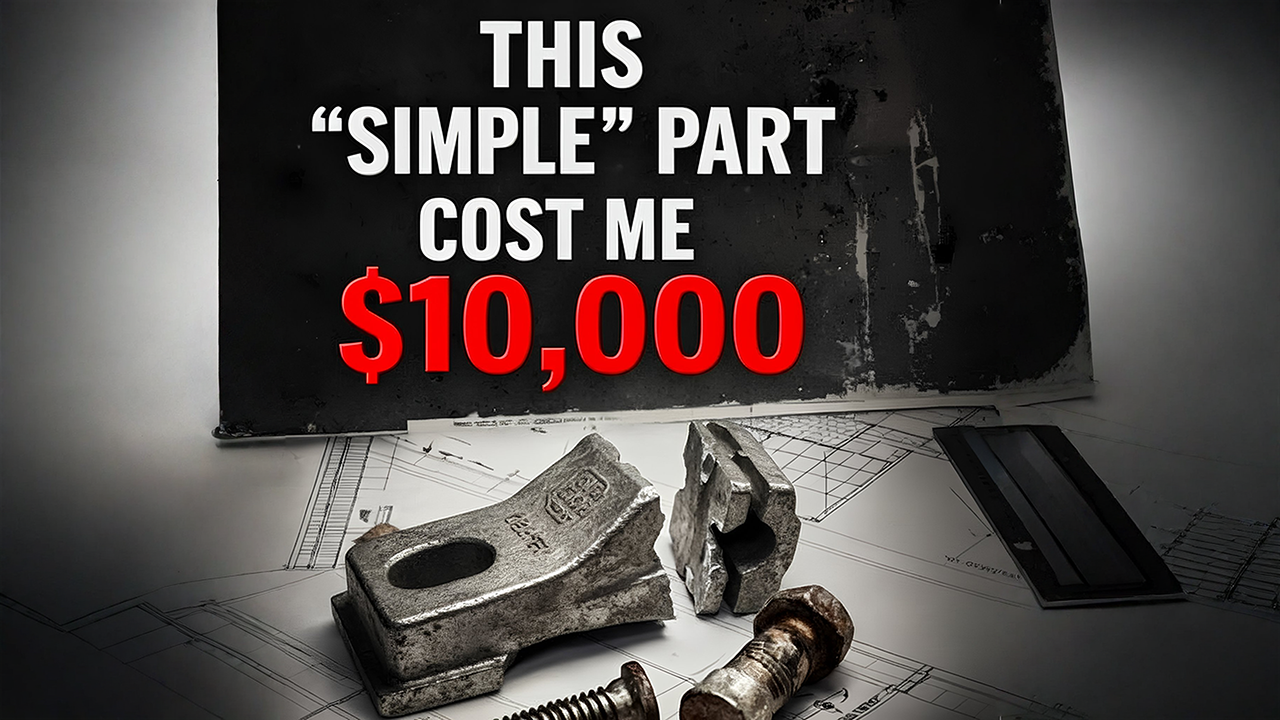
The least complex design elements frequently turn out to be the priciest.
Costly lessons, sometimes five figures, stemmed not from bad ideas, but from overlooked small decisions. The issue might be an undersized screw, a plastic wall that appeared solid in the CAD model but wasn’t, or two metals that failed because of galvanic corrosion.
After decades as a mechanical engineer in automotive and aerospace, and as an entrepreneur covering my tooling costs, I’ve realized that costly mistakes are seldom caused by high-profile features. Rather, they hide in ordinary specifics: clearances, allowances, or junctions of parts. Many founders incur costs exceeding $10,000 for what they considered “easy” fixes. I’ve had to redesign things myself after facing unexpectedly high tooling quotes.
Product designers often create in isolation. They become enamored with their CAD models instead of thinking about real-world manufacturing. Each technique, such as injection molding, machining, sheet metal fabrication, and die casting, comes with its own set of rules. The invoice will teach you a lesson if these are disregarded.
Rather than waiting for the drawings to be polished, or the renders perfected, I present manufacturers with early rough drafts and ask, “What’s wrong with this?” My ability to make changes that are expensive for them depends on early detection.
Tolerance stack-ups are another common problem. You find yourself hand-fitting production parts or re-cutting tools, which is just watching your money disappear.
We should talk about 3D printing. I rely on constantly; however, it can be deceptive. 3D-printed prototypes can validate concepts, but they don’t guarantee manufacturing feasibility. There’s a risk of disappointment in large-scale production if one gets too invested in a prototype.
Also, expense is directly related to how long assembly takes. If there’s a possibility of installing a piece incorrectly, someone will eventually do it, and this understanding stems from experience, not pessimism.
The harsh truth? It’s usually a matter of starting too fast, rather than negligence, that leads to these unfortunate events. Each subsequent step in the process significantly increases the cost of making corrections. I’ve made these errors myself, and facing the financial consequences is a memorable lesson.
Individuals who avoid these common mistakes aren’t necessarily geniuses; they just ask three essential questions from the outset:
What is the process for making this?
How do you assemble this?
In what ways could this fail?
By slowing down early, they avoid having to halt progress later.
Get free access to the resources I put together to help you with the process of bringing a physical product to market: Click Here!